Yoga Nidra and Sleep: What Does the Research Actually Say?
Yoga Nidra and Sleep: What Does the Research Actually Say?
Yoga Nidra is frequently described as “yogic sleep.”
That phrase can create an understandable assumption:
Is Yoga Nidra actually a substitute for sleep?
Online, the claims can become even more dramatic. You may encounter statements suggesting that a short Yoga Nidra practice provides the equivalent of several hours of sleep.
Those claims are attractive.
But what does contemporary research actually tell us?
Researchers are increasingly studying Yoga Nidra in relation to sleep, stress, anxiety, depression, and other measures of well-being. The results are intriguing—but they are also a good reminder of why we should distinguish promising evidence from established evidence.
What Is Yoga Nidra?
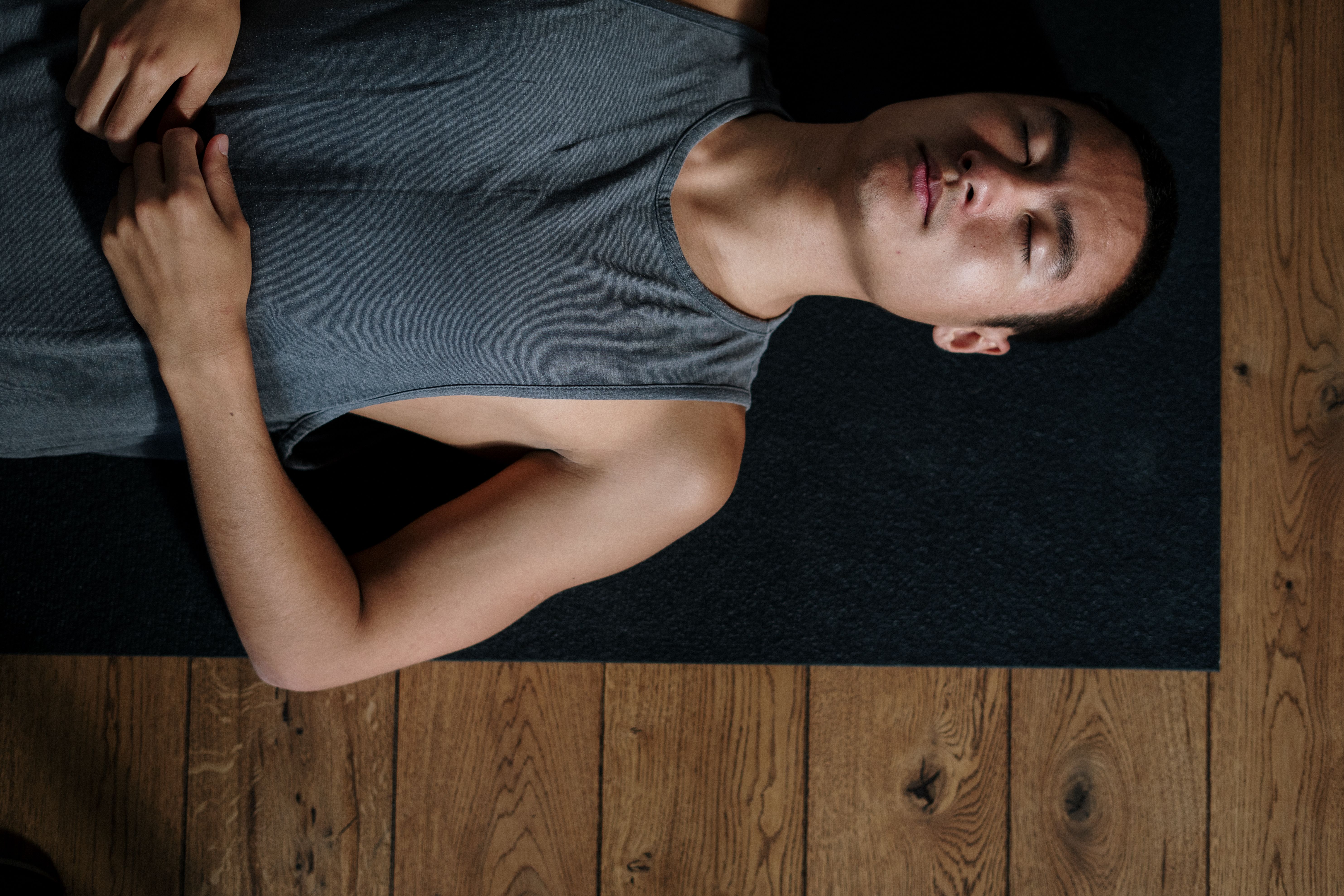
Yoga Nidra is a guided contemplative practice generally performed while the practitioner rests comfortably, often lying down.
Unlike a movement-based yoga class, the primary practice is not physical effort.
Attention is guided inward.
Different Yoga Nidra traditions and contemporary adaptations may include body awareness, breath awareness, intention, imagery, observation of sensations, or a systematic movement of attention through the body.
The practitioner is resting, but the intention is generally to maintain some degree of awareness.
That is one reason translating nidra simply as ordinary sleep can be misleading.
Yoga Nidra occurs in a state of profound physical rest, but the practice involves awareness within that rest.
What Does the Research Say About Yoga Nidra and Sleep?
A 2026 systematic review and meta-analysis specifically examined Yoga Nidra for sleep disturbances and insomnia.
Researchers reviewed randomized controlled trials and observational studies involving adults experiencing poor sleep or insomnia.
Only five unique studies ultimately contributed to the quantitative analyses.
That fact alone is important.
Yoga Nidra may have longstanding roots as a contemplative practice, but the modern clinical evidence specifically examining its effects on sleep remains relatively young.
Among randomized controlled trials examining sleep quality, the pooled results favored Yoga Nidra but did not reach statistical significance. Observational studies reported significant improvements.
Similarly, randomized studies examining insomnia severity produced favorable estimated effects that did not reach conventional statistical significance.
Because of small sample sizes, methodological limitations, and substantial differences among the available studies, the researchers rated the overall certainty of the evidence very low. They described the findings as preliminary and hypothesis-generating.
You can read the publicly available research summary here:
The conclusion is not that Yoga Nidra has no relationship with sleep.
It is that more rigorous research is needed before strong clinical conclusions can be made.
Earlier Sleep-Laboratory Research Is Also Interesting
An earlier randomized sleep laboratory study examined Yoga Nidra in adults reporting insomnia.
Researchers concluded that Yoga Nidra was well tolerated and feasible in this population and observed physiological changes during the practice, including a reduced respiratory rate. They emphasized, however, that these early findings require confirmation in larger and more definitive studies.
The full study is freely available through the U.S. National Library of Medicine:
A Closer Look at Yoga Nidra: Early Randomized Sleep Lab Analyses
This type of research is useful because it goes beyond testimonials and examines what is happening objectively during and around the practice.
Promising Is Not the Same as Proven
This distinction matters.
Saying that research on Yoga Nidra is promising does not diminish the practice.
It simply describes the evidence accurately.
Someone can have a deeply restorative experience during Yoga Nidra without that experience proving a particular medical outcome.
Likewise, researchers can observe encouraging results without having enough evidence to conclude that Yoga Nidra treats insomnia.
Traditional practice, individual experience, and scientific evidence answer different questions.
We do not need to collapse them into one another.
What About Stress, Anxiety, and Depression?
The research landscape becomes considerably larger when we look beyond sleep.
A 2026 systematic review and meta-analysis examined 73 Yoga Nidra studies involving 5,201 participants. Researchers reported favorable effects for stress, anxiety, and depression when Yoga Nidra was compared with active and inactive comparison groups.
However, the researchers also emphasized an important limitation: the methodological quality of many studies was low, and substantial differences existed among the interventions and study designs.
That means the estimated effects may be larger than the true effects.
The full article is publicly available through PubMed Central:
Effects of Yoga Nidra on Stress, Anxiety, and Depression: A Systematic Review and Meta-Analysis
Again, this is why reading beyond a headline matters.
“Research found favorable effects” and “research has established an effective treatment” are not equivalent statements.
Research Is Also Examining Shorter Yoga Nidra Practices
A randomized controlled trial published in 2025 examined both 11-minute and 30-minute online Yoga Nidra practices.
Participants practicing either version reported small improvements in stress, anxiety, and depression compared with the control group, suggesting that researchers are also beginning to ask whether shorter practices can be useful and sustainable.
The complete study is available free through PubMed Central:
This interests me because contemplative practice does not always require long sessions to become part of everyday life.
Rest Without Having to Accomplish Rest
There is another reason Yoga Nidra may feel particularly relevant today.
Contemporary wellness culture can turn even rest into something to optimize.
We track sleep.
Score recovery.
Measure readiness.
Search for the perfect evening routine.
Eventually, we can become strangely busy trying to rest correctly.
Yoga Nidra offers another possibility.
Lie down.
Become comfortable.
Listen.
Notice.
Follow awareness inward.
You do not have to achieve a particular state.
You do not even have to force yourself to relax.
Rest becomes the environment in which the practice occurs rather than another accomplishment.
Yoga Nidra Within the Inner Coherence Method™
I also incorporate short Yoga Nidra experiences into Level One of my seven-week, in-person Inner Coherence course.
The course explores different ways to develop awareness and greater inner coherence rather than relying on a single technique. Short Yoga Nidra sessions provide students with an opportunity to experience conscious rest and inward attention as part of that broader process.
The next seven-week Inner Coherence Level One course begins Wednesday, September 9.
If you are interested in experiencing Yoga Nidra alongside meditation, mindful movement, self-observation, and other practices within the Inner Coherence Method™, you can learn more and register here:
Learn More & Register for the Seven-Week Inner Coherence Course
Does Yoga Nidra Replace Sleep?
Based on the available evidence, no responsible conclusion supports treating Yoga Nidra as a replacement for adequate sleep.
Sleep is a fundamental biological process.
Yoga Nidra is a contemplative practice.
The two may interact in interesting ways, and researchers are actively investigating that relationship.
But they are not interchangeable.
Perhaps Yoga Nidra becomes more interesting when we stop trying to make it something it is not.
It does not have to replace sleep.
It does not have to perform a miracle.
It can simply become an opportunity to explore conscious rest.
And in a culture that often treats stopping as unproductive, learning how to rest consciously may itself be a meaningful practice.
Explore the Research
The following resources are publicly accessible online:
Singh S, et al. (2026). Effect of Yoga Nidra (Yogic Sleep) in Sleep Disturbances and Insomnia: Systematic Review and Meta-Analysis.
Sleep and Breathing.
Ghai S, Odyniec P, Ghai I. (2026). Effects of Yoga Nidra on Stress, Anxiety, and Depression: A Systematic Review and Meta-Analysis.
Annals of the New York Academy of Sciences.
Sharpe E, et al. (2023). A Closer Look at Yoga Nidra: Early Randomized Sleep Lab Analyses.
Moszeik EN, et al. (2025). The Effects of an Online Yoga Nidra Meditation on Subjective Well-Being and Diurnal Salivary Cortisol.
This article is provided for educational purposes and is not intended as medical advice or as a substitute for appropriate medical or mental-health care.
Alchemy Joy™
Transformative living through spirit, beauty, and joy.