What Is Qigong? Ancient Practice, Mindful Movement & Modern Research
What Is Qigong? Ancient Practice, Mindful Movement & Modern Research
At first glance, Qigong can look deceptively simple.
A practitioner stands quietly. The arms move slowly. The breath remains calm. There may be no dramatic posture, heavy weight, or obvious cardiovascular effort.
But the simplicity of the movement doesn't mean nothing is happening.
Qigong is a traditional Chinese mind-body practice that brings together movement, posture, breathing, and focused awareness. While its roots reach back centuries, Qigong is also receiving increasing attention from researchers interested in its potential applications for health and well-being.
What Does Qigong Mean?
The word Qigong is commonly understood through two concepts.
Qi refers, within traditional Chinese thought, to vital energy or life force.
Gong refers to skill, cultivation, or an ability developed through sustained practice.
Qigong can therefore be understood broadly as the cultivation of qi through practice.
Traditional Qigong encompasses many forms, but researchers identify common principles, including regulating or coordinating the mind, breath, and body.
It is important, however, to distinguish the traditional understanding of qi from contemporary scientific research. The traditional concept of qi should not be presented as though science has established it as a measurable biological substance. These are different frameworks for understanding the practice.
Researchers can investigate observable outcomes associated with Qigong practice—such as changes in physical function, quality of life, fatigue, stress, mood, balance, and other measures of physical and psychological well-being.
What Does Modern Research Say About Qigong?
Scientific interest in Qigong has grown substantially.
A 2026 analysis published in Frontiers in Medicine examined the global Qigong research landscape from 2005 through 2025. Researchers identified 1,730 publications through the Web of Science Core Collection and 387 clinical studies through PubMed. Of the PubMed clinical studies, 266 were randomized controlled trials.
The researchers found that publication activity had generally increased over the two decades, with a notable rise beginning around 2018. Research has explored Qigong in relation to physical and cognitive health, quality of life, aging, mental and behavioral health, and various health conditions. Baduanjin was the most extensively studied Qigong form in their analysis, followed by Liuzijue and Yijinjing.
This doesn't mean Qigong has been scientifically proven to treat every condition under investigation.
It tells us something different—and important:
Qigong has become a substantial area of scientific inquiry.
An earlier systematic review, published in 2020 and freely available through the National Library of Medicine's PubMed Central, examined 28 clinical studies involving adults and older adults. The studies investigated Qigong in relation to a wide range of health conditions and outcomes. The review reported positive findings across several areas, but it also identified important methodological concerns, including a significant risk of bias related to blinding in the studies.
That distinction matters.
Promising evidence is not the same as proof.
Research quality varies. Different styles of Qigong are studied. Participant populations differ. Interventions vary in length and frequency. And some outcomes have considerably more evidence behind them than others.
We don't have to choose between appreciating a traditional practice and thinking critically about contemporary evidence.
We can respect Qigong's history and philosophy while remaining thoughtful about what modern research can—and cannot—establish.
Qigong Is Also an Experience
Research can measure outcomes.
It cannot completely describe what practicing Qigong feels like.
During Qigong, movement may become slower and more deliberate. Attention begins moving toward sensation. Breathing becomes part of the movement rather than something happening unnoticed in the background.
Instead of trying to accomplish more, the practitioner may begin noticing more.
How does the body respond when movement slows?
What happens when the breath and movement begin working together?
Where are you holding unnecessary tension?
Can you remain attentive without forcing?
These are things that are difficult to understand simply by reading about them.
They become clearer through experience.
This is also one reason Qigong can complement practices such as yoga and meditation without being identical to either.
What Are the Five Elements?
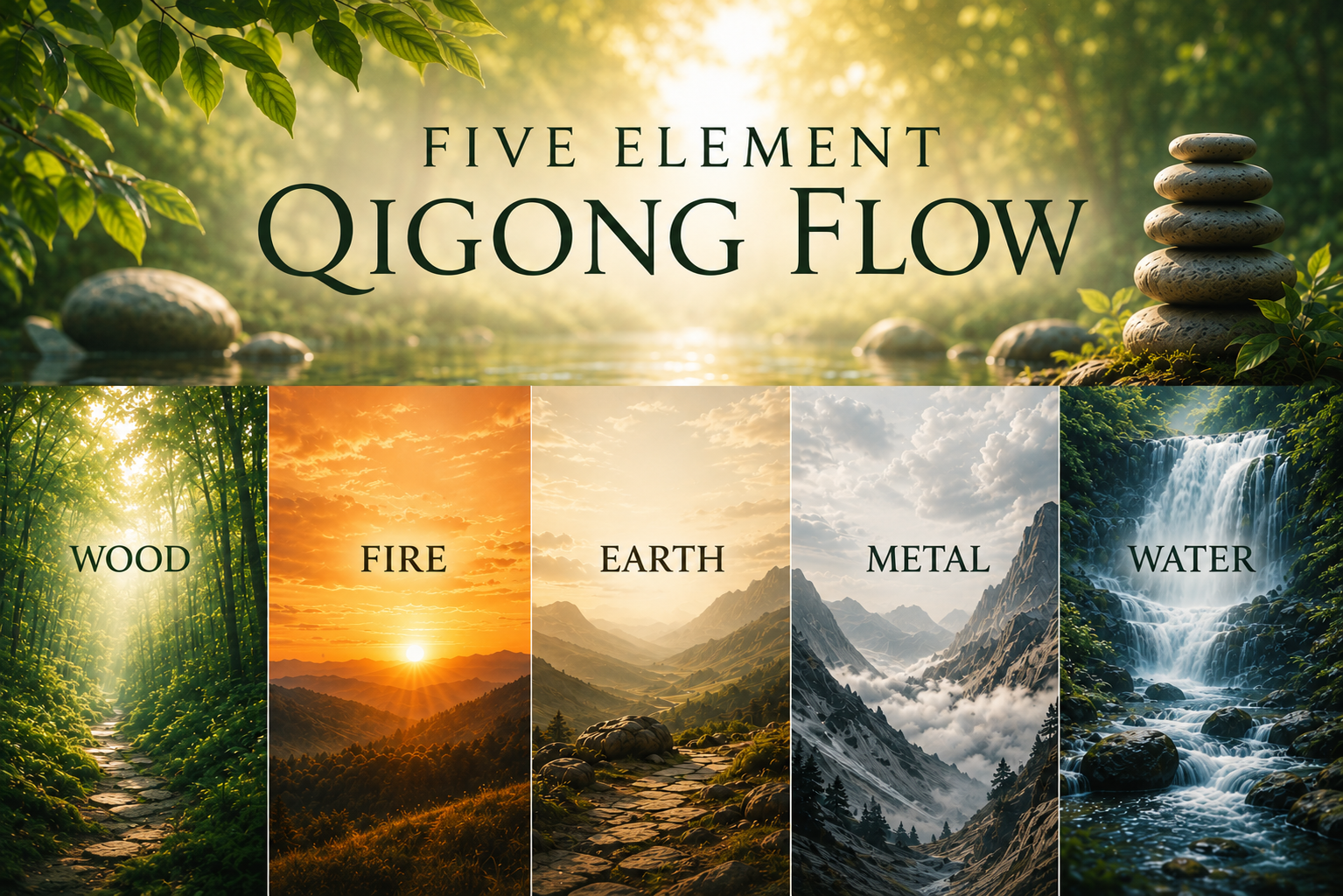
Traditional Chinese philosophy describes Five Elements—or Five Phases: Wood, Fire, Earth, Metal, and Water.
Rather than thinking of them simply as five physical substances, they can be understood as dynamic qualities and patterns of change within nature.
Different Qigong traditions work with the Five Elements in different ways. Within practice, the elements may provide a framework for exploring qualities of movement, breath, attention, balance, and our relationship with the natural world.
You don't have to memorize an entire philosophical system before experiencing them.
You can begin through movement.
You Don't Need Previous Experience
You don't need to be flexible.
You don't need to be athletic.
And you don't need to understand Chinese philosophy before beginning.
You can learn through practice.
Move.
Breathe.
Notice.
Repeat.
Sometimes something that appears very simple from the outside becomes much richer when experienced from within.
Experience Qigong for Yourself
If you're curious about Qigong, one of the best ways to understand the practice is to experience it.
My Five Element Qigong Flow Immersion begins Wednesday, August 12, in Medford, New Jersey.
Over four weeks, we'll explore Wood, Fire, Earth, Metal, and Water through intentional movement, breath, focused awareness, and Qigong practice.
No previous Qigong experience is necessary.
An optional fifth class will also be available for those who would like to continue and deepen the experience.
Five Element Qigong Flow Immersion
Begins Wednesday, August 12
Medford, New Jersey
https://momence.com/Alchemy-Joy-Inc./Five-Element-Qigong-Flow/138645965
Explore the Research
If you'd like to explore some of the scientific literature for yourself, these two peer-reviewed articles are freely available to the public:
Global Perspectives and Clinical Trends in Qigong Research: A Bibliometric and Visual Analysis (2005–2025)
Frontiers in Medicine, 2026
This recent paper examines two decades of Qigong research, including publication trends, clinical research, frequently studied Qigong forms, health conditions, and emerging areas of investigation.
Read the full Frontiers in Medicine article
Benefits of Qigong as an Integrative and Complementary Practice for Health: A Systematic Review
Revista Latino-Americana de Enfermagem, 2020
This systematic review examined 28 clinical studies involving adults and older adults, reporting promising findings while also identifying methodological limitations in the available research.
Read the full article free through PubMed Central
This article is provided for educational purposes and is not intended as medical advice or as a substitute for care from a qualified healthcare professional.
Alchemy Joy™ — Transformative living through spirit, beauty, and joy.