When the River Changes Course
When the River Changes Course
On practicing non-attachment
By LaRonda Koffi
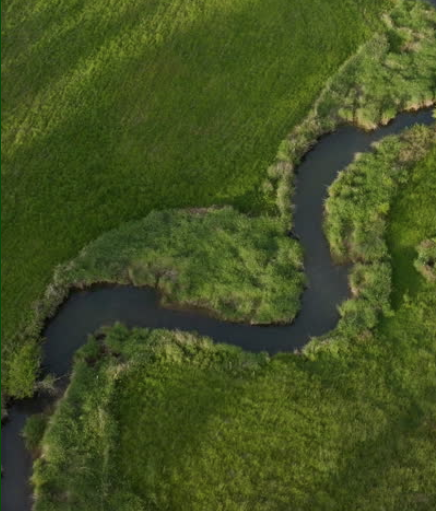
My husband and I were talking the other day about how something that looks like a disaster at first can sometimes make room for something good. I said, “Imagine there’s a small river. Lightning hits a tree, and the tree falls across the water.”
My first thought would be about what’s downstream. What happens to the places that depend on that river? But imagine some of the water takes a different path. Over time, it reaches a stretch of land that used to be dry. Plants take root. Animals find their way there. Maybe people nearby can even grow food they couldn’t grow there before. If I’d walked away right after the tree fell, all I would have seen was a river that couldn’t go where it used to go.
I keep coming back to that conversation because several things in my life feel less stable than they once did. I like having a plan, and when something changes, my first instinct is to figure out how to get things back on track. Lately I’ve been asking myself how much of my energy I spend trying to get back to the way I thought things were supposed to go.
That’s where non-attachment comes in for me. I still have a vision for my life. I can keep that vision alive and give myself room to see how it might take shape. Sometimes going with the flow means taking a step I hadn’t considered. Sometimes it means sitting with a question for a while, even when I’d really like an answer by Friday.
What I mean by non-attachment
In the yoga tradition, Patañjali uses the Sanskrit word vairāgya, often translated as non-attachment or dispassion. In the Yoga Sūtras (1.12–1.15), he pairs it with steady practice as a way to quiet the movements of the mind. I think of it as loosening my grip on what I want long enough to see what’s actually happening. Yoga Sūtra 1.12–1.15
In my life right now, that means I can care deeply about how things turn out and still catch myself when I start thinking they have to happen a certain way. I can do what’s mine to do today. If the situation changes tomorrow, I can look at it again and decide what makes sense then.
What I return to when things shift
I think of the words from the New Testament of the Bible that say “all things work together for good to them that love God” (Romans 8:28, KJV). That phrase, to them that love God, matters to me. It speaks to where I place my trust while I’m still in the middle of things. In the Tanakh, Joseph can look back and tell his brothers, “although you intended me harm, God intended it for good” (Genesis 50:20, JPS). I think about how different that story must have looked to Joseph while he was living through it.
The Qur’an says, “Perhaps you dislike something which is good for you and like something which is bad for you” (2:216, The Clear Quran, excerpt). That word perhaps gives me some breathing room. How many times have I decided exactly what a change meant for my life before I’d even had time to live with it?
The Bhagavad Gita brings me back to what I can do today. Krishna asks Arjuna to “be steadfast in performing your duties, abandoning all attachment to success and failure” (2:48, excerpt). The Dhammapada asks me to consider how I meet the result once it arrives. In verse 83, the wise keep their composure “when faced with joy or sorrow” (translation by Daw Mya Tin, excerpt). And in the Avesta, Zarathustra asks us to “reflect with a clear mind” (Yasna 30.2, Stanley Insler translation, excerpt). I hear that as an invitation to give myself a moment before I choose how to respond.
Then there’s the Tao Te Ching. “The highest excellence is like (that of) water,” says James Legge’s translation (chapter 8). The passage goes on to describe how water benefits all things and goes to places people avoid. It takes me right back to that stretch of dry land I imagined with my husband.
Keeping my equilibrium
A change in my plans can feel like a change in who I am, especially when I’ve spent a long time picturing what comes next. I’m learning to catch myself in that moment. There’s the personality I know as LaRonda, with her ideas about how things ought to go. There are other people’s ideas about who I am. And there is what I think of as my eternal self, something deeper than even my own definition of who I am. Remembering that helps me find my balance again.
I can be disappointed and give myself time to feel it. I can take care of what needs my attention today and leave a little room for what I can’t see yet. I think that’s part of trusting my purpose. It can still find expression through my life even when the form I imagined changes.
As Thanksgiving approaches, I’m grateful for the lessons. Some changes are still difficult to understand, but I’m thankful for the patience I’m learning, the people beside me, and the moments that help me see more clearly. There’s room for gratitude while I’m still finding my way.
What seems like chaos today may be creation tomorrow. I’m still close enough to the fallen tree that some days it’s all I can see. I’m learning to look a little farther down the river.
A little everyday alchemy
Here are two things I’ve created for exploring transformation in different ways.
Athanor: Nigredo — Chapter One
My contemplative puzzle game explores the symbolism of Nigredo, the dark beginning of transformation in Western alchemy. Work through three trials of Salt, Mercury, and Sulfur to unlock an eight-minute guided meditation. Available for Android on Google Play.
Explore Athanor on Google Play
Seven Cups of Alchemy
For a little alchemy in the kitchen, my digital recipe booklet brings together seven seasonal coffee recipes you can make with a Keurig or your favorite brewed coffee. Try a new cup on a quiet morning or make one to share over the holiday.